




Do Cleaning Robots Work in Cold Storage and Winter Warehouses?

Cleaning robots do work in cold storage and winter warehouses, but only if their operating temperature range matches your facility’s conditions. The deciding spec is the lowest rated operating temperature, not an “industrial-grade” label. Battery performance, sensor reliability, and moisture protection also affect how well it operates in the cold. For freezer areas below -10°C, no robot in the range is rated, so get a written temperature rating from the manufacturer before you commit.
Key Takeaways
- Cold types: Cold storage and a seasonally cold warehouse are different problems, so each one needs its own cleaning approach.
- First to fail: Battery capacity, sensor accuracy, and material seals are the first things to fail as temperatures drop, often within the first winter.
- Battery impact: Cold cuts lithium-ion battery capacity and speeds up wear, so runtime drops noticeably in a cold room and recharging takes more planning.
- IP54 meaning: IP54 protects against dust and water spray, but it doesn't cover a direct hose-down or pressure-washing.
- PUDU MT1 Max: The MT1 Max works from -10°C to 45°C with full IP54 sealing. It covers seasonal cold, cold rooms at 0–5°C, and cold rooms down to -10°C in one robot.
- Dry cleaning fit: Cold-room floors are rarely washed because water would freeze on the surface, so an autonomous dry sweeper is the practical choice.
- PUDU MT1 Vac: The MT1 Vac works down to -10°C and handles fine dust well in chilled rooms. It only charges between 0°C and 40°C, so its charging station needs a heated spot.
- Freezer limit: Below -10°C, neither robot is rated. Talk to Epic Robotics before planning any freezer deployment, so you get a tested answer and not a guess.
Cold Storage Temperature Ranges and Where Your Facility Fits
Cold facilities fall into four temperature bands, and many buildings span more than one. Map each zone before you compare robots.
- An ambient warehouse stays near room temperature all year.
- A seasonal warehouse drops in temperature during winter without refrigeration. Unheated bays, older buildings, and loading docks with dock doors cycling open all qualify.
- Refrigerated cold storage, often called the chilled zone, holds 0–5°C year-round with mechanical refrigeration. Some cold rooms run lower, between -10°C and 0°C.
- Freezer storage runs below -10°C, and Health Canada advises keeping frozen food at -18°C or colder.
A warehouse that dips to 10°C in January is a different problem from a -18°C freezer. Equipment that runs well in one can fail outright in the other.
Example: A distribution centre’s loading dock sits at 8–10°C on a January morning, its chilled produce room holds 2°C, and its blast-freezer staging area runs at -15°C. The dock and the chilled room both sit inside the PUDU MT1 Max’s rated range. The staging area does not, because -15°C is below the robot’s -10°C limit, so it needs a direct assessment.
What Breaks Down First in Cold Storage as Temperatures Drop
Three things fail first in any autonomous sweeper as the temperature drops: battery capacity, sensor accuracy, and material integrity.
Battery capacity drops first and fastest. Cold slows the chemical reaction inside a lithium-ion cell and, in extreme cases, can crack the battery’s internal materials, according to research from SLAC National Accelerator Laboratory. Peer-reviewed research on low-temperature lithium-ion performance also shows that charging and running cells in the cold speeds up long-term wear. In practice, expect shorter runtime per charge in a cold room than on a warm floor.
Sensors come next. Fog, frost, and condensation form where a cold zone meets a warmer one. They interfere with the cameras and LiDAR (laser-based mapping) a robot uses for navigation. When a robot crosses from a warm dock into a cold room, condensation can form on its sensors, and lower-grade sensor systems lose positioning accuracy at that transition zone.
Materials and seals matter too. Standard plastics, rubber seals, and brush bristles stiffen under sustained cold. Cold-rated equipment is sealed and tested at its stated temperature. A bigger bolted-on battery doesn’t replace that.
Quick tip: Ask every vendor for the tested operating temperature range in writing. An assumed range based on “industrial-grade” components is not enough.
Confirmed Specs: How the PUDU MT1 Max Handles Each Cold Zone
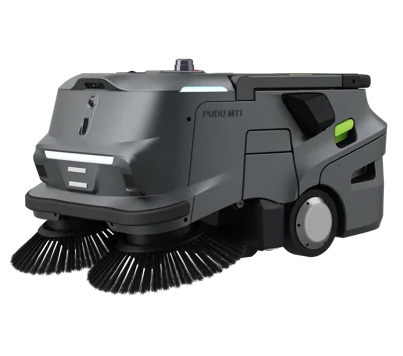
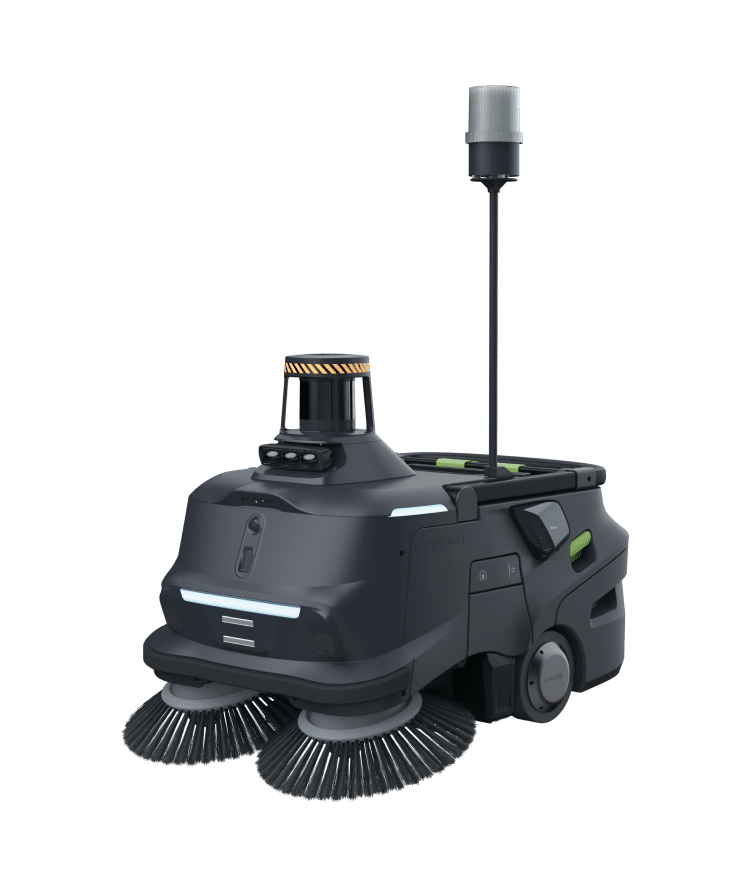
The PUDU MT1 Max is an autonomous dry sweeper with 3D perception, rated to operate from -10°C to 45°C, with a built-in temperature sensor and full IP54 sealing against dust and water spray.
Under the IEC 60529 ingress protection standard, IP54 means the unit is dust-protected and resistant to water spray from any direction.
Its VSLAM + Marker + 3D LiDAR SLAM navigation is designed to hold position even in heavy dust and fog. That matters because fog and condensation are heaviest right at the boundary between a warm dock and a cold room.
Here is how the rated range maps to each zone:
- Seasonal cold (above 0°C): within range.
- Cold room, 0–5°C: within range.
- Cold room, -10°C to 0°C: within range, at the lower end of the rating.
- Freezer, below -10°C: not rated. Talk to Epic Robotics directly instead of guessing.
Three practical points before you deploy. First, the MT1 Max is a dry sweeper, which suits cold rooms where floors can’t be washed because water would freeze. Second, it stands 675 mm tall, so check clearance under the lowest beam level of your racking. Third, PUDU advises against running cleaning tasks in extreme weather, so keep routes away from dock doors that open onto winter storms. It covers up to 2,200 m²/h in area cleaning and runs 5–10 hours per charge.
Quick tip: IP54 protects against dust and spray, but it doesn’t cover a full hose-down. If your cleaning protocol includes pressure-washing a zone, check that requirement with Epic Robotics separately, because it is a different question than cold tolerance.
When the PUDU MT1 Vac Fits Better
The PUDU MT1 Vac is an autonomous sweeper and vacuum that sweeps, vacuums, and dust mops in one dry cleaning system, with HEPA filtration. Its working range is -10°C to 40°C, so it can operate in the same cold rooms as the MT1 Max.
It suits cold rooms where the problem is fine dust and light debris rather than heavy packaging waste, such as chilled food and temperature-controlled pharmaceutical storage. Keep three limits in mind.
- Charging: it charges only between 0°C and 40°C, so place its charging station in a heated area outside the cold room.
- Debris volume: its 6 L bin is built for fine dust, not bulky waste. For heavy debris, the MT1 Max is the better fit.
- Indoor only: it is rated IPX3, so keep it away from open docks and semi-outdoor areas.
Its runtime is 3–6.5 hours per charge, shorter than the PUDU MT1 Max, so plan cleaning cycles around trips back to the warm charging area.
Is a Cleaning Robot Worth It in Cold Storage?
A cleaning robot pays off in cold storage when your facility has large, continuous hard-floor areas and a regular cleaning need.
Cold zones are among the hardest shifts to staff, and cold-environment premiums raise janitorial costs. Slip risk is higher at 0–5°C, where workers stiffen up and react more slowly, a hazard the Canadian Centre for Occupational Health and Safety covers in its guidance on working in the cold. Every hour a robot sweeps a cold zone is an hour your team spends out of the cold.
The documentation benefit is easy to overlook. Both robots produce automatic cleaning reports in the PUDU Link app and dashboard. These records support audit documentation for provincial OH&S rules and National Fire Code of Canada housekeeping, and they replace manual cleaning logs. Supervisors can also confirm each cold zone was swept on schedule.
On cost, payback depends on floor area, cleaning frequency, and what you spend on cold-zone labour today. Large, continuous floors pay back faster. Smaller or irregular floor areas pay back more slowly, so measure your cleanable floor area before you decide.
Final Words: So Do Cleaning Robots Work in Cold Storage?
Yes. Cleaning robots work in cold storage, as long as the robot’s rated temperature range matches your coldest zone. The PUDU MT1 Max covers seasonally cold warehouses, cold rooms at 0–5°C, and cold rooms down to -10°C, with IP54 sealing and 3D LiDAR built for the dust, moisture, and fog that come with them. For fine dust in chilled rooms, the PUDU MT1 Vac is also rated to -10°C, as long as it charges in a heated area. Below -10°C, a direct conversation is the right step, because neither robot is rated that low.
Not sure which zones a robot can handle? Talk to the Epic Robotics team. We will review your facility’s actual zone temperatures with you and match the right robot to your coldest zone before you buy anything. Compare the PUDU MT1 Max and PUDU MT1 Vac to see the specs side by side.
Recent Blog
4-in-1 Scrubber or Industrial Sweeper? Pick the Right Robot

October 25, 2026
Autonomous Cleaning Robot ROI: Costs, Payback and Savings
October 24, 2026
Do Cleaning Robots Work in Cold Storage and Winter Warehouses?
October 24, 2026

Ready to Get Started?
All-in-One Cleaning Solution:Sweeping, Scrubbing,
Vacuuming and Dust-mopping


